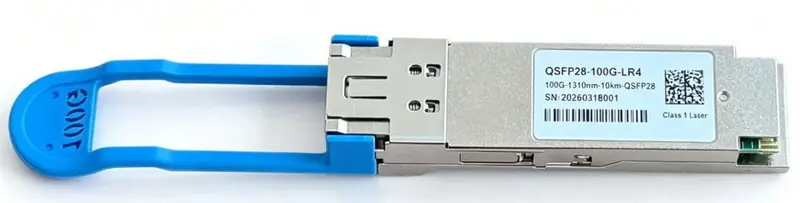
Three 100G QSFP28 variants cover most metro and data center interconnects, and they are not interchangeable. Here is how to pick between LR4, CWDM4 and PSM4 based on fiber type, distance and what you already have in the ground.
The three candidates
| Variant | Optics | Reach | Fiber |
|---|---|---|---|
| QSFP28-100G-LR4 | 1310nm LAN-WDM, 4 wavelengths | 10km | Single-mode duplex |
| QSFP28-100G-CWDM4 | 1271-1331nm CWDM, 4 wavelengths | 2km | Single-mode duplex |
| QSFP28-100G-PSM4 | 1310nm parallel, 4 fibers each way | 500m to 2km | Single-mode, 8 fibers or MPO |
How to decide
- If the run is between buildings and you have duplex single-mode available, LR4 is the safe default up to 10km.
- If the run is inside a campus or a metro POP at 2km or less, CWDM4 usually costs less than LR4 for the same job.
- If you already run MPO trunk cabling, PSM4 lets you use the existing fiber count instead of pulling new duplex strands.
The mistake worth avoiding
The three variants do not interoperate with each other on the same link. Mixing them at either end is the most common cause of a link that comes up physically but never passes traffic. Confirm both ends before ordering, and if you are unsure, send us the equipment models and we will confirm the pairing.
Fiber plant matters as much as the module
Every one of these links is only as good as its connectors. Low insertion loss patch cords with verified return loss, and clean end faces, prevent the intermittent errors that people usually blame on the optic.
Questions about this topic?
Send us the equipment model and the link requirements you are working with — our engineering team will recommend the matching configuration.
Request technical advice