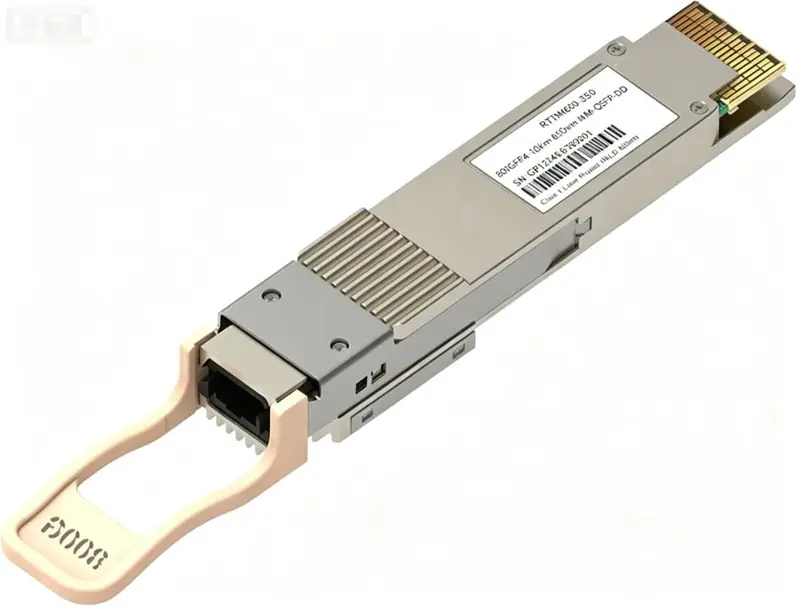
Both 800G form factors carry the same 8x100G PAM4 electrical lane structure, so the decision is rarely about speed. Thermal headroom, port density and the switch platform you already run usually settle it.
At 800G there are two mainstream pluggable form factors: OSFP and QSFP-DD800. They are frequently presented as competing standards, but electrically they are far more alike than different — both run eight lanes of 100G PAM4. In practice the choice is decided by the hardware around the module rather than by the module itself.
What actually differs
- Size and thermal mass — OSFP is slightly larger, which gives it more surface area and generally more thermal headroom. In dense, hot cages this is the reason OSFP is often the easier part to cool.
- Port density — QSFP-DD800 follows the familiar QSFP footprint, so a chassis designed around QSFP-DD400 can often reach 800G without a mechanical redesign. Where the platform already exists, this usually wins.
- Backward compatibility — QSFP-DD800 ports commonly accept QSFP28 and QSFP-DD400 modules, which protects a staged migration. OSFP ports have their own adapter story.
- Cable and optics ecosystem — both have mature DAC, AOC and optical options now, but availability for a specific reach can differ by vendor.
How to decide for an AI cluster
Start from the switch platform you are actually deploying. If the chassis is already specified, the form factor is very likely specified with it, and the remaining question is only which optic — SR8 for short reaches inside the pod, DR8 for the longer structured cabling between pods, and FR8 where the run genuinely needs it. Over-specifying reach is one of the more common ways to overspend on an 800G build.
If you are still choosing the platform, work backwards from the thermal envelope and the port count. A design that is already close to its cooling limit should favour the form factor with more headroom, even at some cost in density.
Before you order
Confirm three things with your supplier: the platform the module has been tested against, the DOM ranges you should expect to see, and whether the reach you are buying matches the fiber you already have in the ground. Send us the switch model and the link budget and we will confirm compatibility before the order rather than after it.
Questions about this topic?
Send us the equipment model and the link requirements you are working with — our engineering team will recommend the matching configuration.
Request technical advice